Days 1–12 showed how finance work can be decomposed into executable, reusable units. The final four Bonus Days ask how those units can be combined into analytical products, specialist workflows, and a cross-organizational capability network managed by Finance.
Introduction
Across Days 1–6, OpenAI’s Strategic Finance team showed AI entering marketing spend, sales signals, headcount planning, Opex dashboards, BvA, and close decks. Days 7–12 extended the pattern to P&L refreshes, daily forecasts, account-level adjustments, executive audio, long-range planning models, and approved IR knowledge.
The final four Bonus Days change the unit of design. Instead of asking whether one task can be automated, they address four operating-model questions:
- Can Finance express changes directly on a working analytical product instead of repeatedly translating requests for an engineering team?
- Can a dashboard become a reusable engine that answers new questions without rebuilding every analysis?
- Can a specialist agent coordinate email, project, KYC, and banking-operations work without crossing human authority boundaries?
- When one Finance partner supports more than ten teams, how should shared capabilities, local context, and central orchestration be separated?
From AI4FIN’s analytical perspective, the four cases can be arranged as a progression:
Modify one analytical product directly
→ Build a reusable engine for new questions
→ Build a specialist finance agent with approval boundaries
→ Manage multiple organizational contexts through shared capabilities and orchestration
The value is not a growing number of interfaces or agents. Finance is beginning to manage a portfolio of digital capabilities with input contracts, state, permissions, evidence, review, and lifecycle controls.
The analysis below follows the same structure as the first two features: business problem, required context, AI role, human role, reusable asset, and a practical starting scope.
Part I: Bonus Days 13–14 — Finance Builds and Reuses Analytical Products
Bonus Day 13 | Browser Annotations: Shortening the Distance Between Finance Intent and Product Change
Business problem
An executive dashboard often starts as a sketch in Sheets, becomes a Data Science or engineering request, and then moves through repeated rounds of metric clarification, layout changes, formatting feedback, and post-release revisions.
The expensive part is the translation loop. Finance describes business intent; a technical team translates it into queries and frontend code; Finance reviews the output and explains the remaining gap. Small changes—moving a KPI, correcting an axis, adding a plan line—return to the queue.
Kevin Cong demonstrates a different interaction model: point Codex to tables approved by Data Science and existing dashboard templates, generate a first version, open it in the browser inside the Codex app, annotate a specific region, and request a targeted change. The public GIF shows annotations on a localhost contribution-margin dashboard followed by visible UI updates.
Inputs and context
A controlled version needs approved data sources, a governed metric definition, a versioned template, an explicit as-of date, presentation standards, and a release boundary.
An approved table is not the same as an approved metric. The table may be trusted while generated SQL still selects the wrong grain, duplicates a join, or uses an obsolete mapping. An old template may preserve outdated labels or business logic. Browser annotations can express visual intent; they cannot replace data definitions or reconciliation.
The public material explicitly says Synthetic demo data. It directly shows the browser-annotation interaction pattern, but it does not disclose schemas, SQL, formulas, tests, source control, deployment, or elapsed-time logs.
AI’s role
AI can use approved input contracts and templates to generate a first dashboard, then translate Finance’s region-level comments into code changes. A deterministic testing layer should run query tests, control-total reconciliation, and visual regression comparisons; AI can explain failures and organize unresolved items for reviewers.
The new capability is not simply chart generation. Business language, the affected page region, and the code change live in one workspace, reducing information loss across screenshots, tickets, and documents.
Every annotation should still create a preview change with a diff. Metric, query, responsive-layout, accessibility, and sensitive-data checks must run again before release. Faster browser iteration should not bypass version control.
Human role
Finance owns the metric, interpretation, decision purpose, and the approval that a visual change did not alter business meaning. Data owners approve source, grain, joins, and metric versions. Reviewers inspect query tests, control totals, screenshot differences, and sensitive-data exposure.
The workflow should distinguish preview, review ready, approved, and published. Any change to a source, formula, or metric version should invalidate the previous approval.
Reusable asset
Bonus Day 13 can become a finance-owned dashboard development loop:
- allowlisted, read-only sources and a semantic layer;
- versioned metric registry and dashboard templates;
- browser annotations linked to code diffs;
- SQL tests, control totals, and join-cardinality checks;
- visual regression, responsive, and accessibility tests;
- preview, review, and publish states;
- lineage across source, template, code, and output.
Finance gains a more direct role in building analytical products without making data engineering and release control invisible.
Practical starting scope
Use a synthetic monthly contribution-margin dataset and three fixed KPIs. Plant one duplicate join and one mislabeled axis, then request three browser-annotation edits.
Pass only if totals continue to reconcile, both planted defects are detected, source and as-of metadata remain visible, every edit has a code diff, and publishing requires approval.
Public evidence boundary: The original GIF directly shows Codex chat, a localhost browser, an approved-finance-data table, a synthetic contribution-margin dashboard, annotations, and visual changes. SQL, lineage, approvals for metric definitions, tests, deployment, and timing logs are not public.
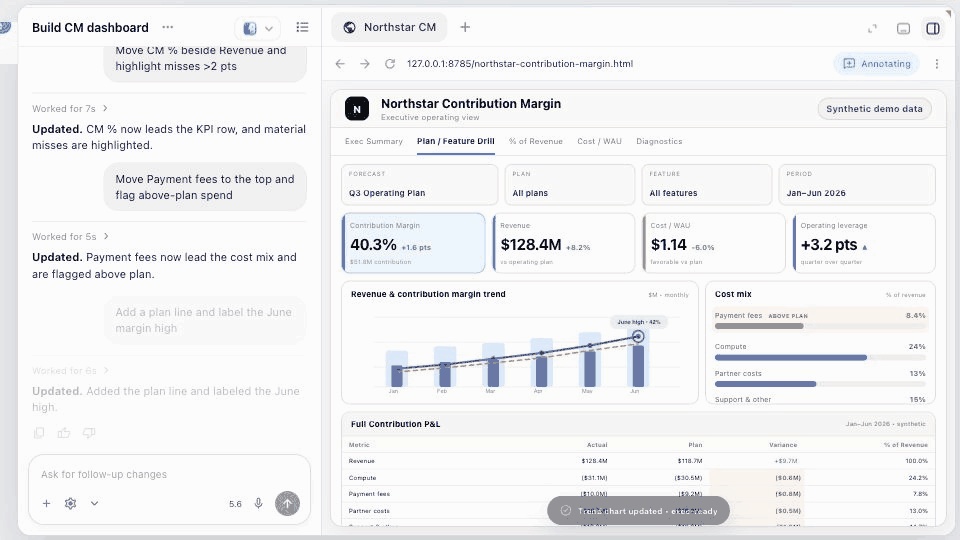
Caption: Browser annotation shortens the path from finance intent to a code change. Metric governance, reconciliation, and release approval remain separate controls.
Bonus Day 14 | API Business Analytics Engine: From One-Off Queries to Reusable Answers
Business problem
API business questions cut across model, customer, segment, usage, token monetization, latency, and compute efficiency. Each new cut may trigger new SQL, coordination with data owners, definition reconciliation, joins, and a one-off report.
That process answers known questions but does not accumulate much capability. A new question starts again; customer, model, and revenue mappings may differ across reports; bridges, cohorts, retention views, and top-account analysis may not share the same as-of date.
Jacob Blau’s 60-second video shows an interactive API analytics application with API ARR by model group, an L7D ARR bridge, Top 25 accounts, customer deep dives, cohort and retention heatmaps, and controls for date, lookback, segment, and model group. He states that Codex helped build the querying, data combination, calculations, refreshes, and reporting views.
Inputs and context
The core is not the number of charts, but the common data and definition layer. ARR, usage, tokens, latency, and compute cost need versioned definitions. Customer, contract, segment, and model mappings need effective dates. Every view must reference a common snapshot.
Without those conditions, interactivity only produces contradictions faster. Cohorts and bridges are especially sensitive to contract-date choices, customer consolidation, model reclassification, late-arriving data, and survivorship bias.
The video establishes interface breadth and interactivity. It does not say whether the data is real, anonymized, or synthetic, and it does not disclose SQL, schemas, refresh jobs, calculations, or permissions.
AI’s role
AI can discover approved datasets, generate constrained queries, organize analytical steps, combine approved datasets, build standard views, and map new business questions to an existing metric registry. Deterministic components should own metric calculation, cache refreshes, bridge closure, permission filtering, and freshness checks. If a question requires a genuinely new definition, the system should return unsupported definition and route it to an owner rather than inventing one.
Every chart should retain its query, source snapshot, metric version, and control total. Bridges must close arithmetically; cohort boundaries must be reproducible; customer deep dives require row-level access control. A partial refresh must show stale or incomplete rather than silently mixing periods.
Human role
Finance and Data jointly own metrics, entity mappings, and exception handling. Business partners decide which questions should become standard reusable views. Reviewers challenge cohort bias, bridge logic, and segmentation—not only presentation quality.
The team must also govern analytical sprawl. Rapidly adding cuts creates maintenance cost. A metric should not become an organizational standard merely because it appears in a polished dashboard.
Reusable asset
Bonus Day 14 can become a governed business analytics engine:
- a common metric and semantic layer;
- effective-dated customer, contract, segment, and model mappings;
- read-only query permissions and row-level access control;
- shared source snapshots and visible freshness state;
- SQL tests, join-cardinality checks, and reconciliation;
- deterministic bridge, cohort, and retention components;
- a novel-question eval set and unsupported-definition queue;
- lineage across queries, calculations, and outputs.
The difference from a conventional dashboard is that new questions reuse approved data contracts, calculation components, and controls rather than creating another one-off report.
Practical starting scope
Use a synthetic SaaS/API dataset to build five standard views: ARR trend, model bridge, Top Accounts, usage/TPM, and contract cohorts. Publish a fixed metric registry and test duplicate joins, late-arriving records, model remapping, and cohort boundaries.
Pass only if every chart traces to source rows and metric versions, totals reconcile, access controls hold, and a novel cut either uses an approved definition or explicitly escalates the missing definition.
Public evidence boundary: The original video directly shows a broad, interactive analytics application. The author’s statements about a one-to-two-day build and automated querying, refresh, and calculations are not independently verified. Underlying data, SQL, definitions, tests, and deployment are not public.
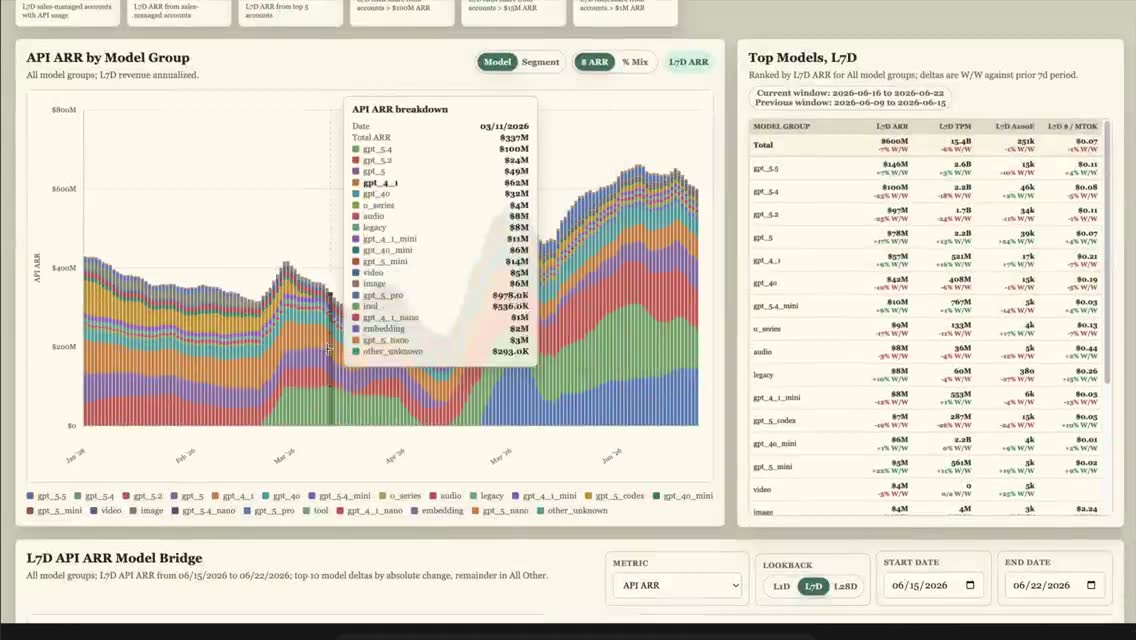
Caption: The test of an analytics engine is not how many views it can add, but whether every new question returns to the same metrics, mappings, snapshots, and controls.
Part II: Bonus Day 15 and the Final Bonus — From Specialist Workflows to a Governed Capability Network
Bonus Day 15 | Treasury Analyst: Designing Speed and Authority Boundaries Together
Business problem
Treasury banking operations manage account openings and closures, signers and mandates, KYC requests, payment and currency enablement, bank blockers, M&A integrations, and project status across multiple legal entities.
Critical state often sits in email, trackers, and individual memory: which entity and account an email belongs to, what evidence is missing, who owns the next action, when follow-up is due, and how a similar request was handled before.
The risk is not only delay. Linking an email to the wrong entity, treating stale precedent as a current bank requirement, inferring signer authority, or sending confidential information to the wrong institution can become a real control incident.
Jane Ro demonstrates a Treasury Analyst plugin wrapped in a Banking Operations application. The demo includes projects, accounts, signers, legal entities, bank contacts, KYC/compliance, control exceptions, migration review, and audit history. Recommendations move into an Analyst approval queue.
Inputs and context
A specialist agent needs controlled company knowledge, project rules, entity and account master data, signer and mandate authority, KYC evidence standards, bank-specific precedent, email playbooks, and portfolio state—not one broad prompt.
Every recommendation should cite the relevant email, project, entity, account, mandate, and precedent. Precedent can help prepare a package; it cannot prove current bank acceptance. Email is untrusted input and requires prompt-injection defenses.
The public application is marked DEMO DATA ONLY and Demo workspace. It also shows Approve, apply & stage draft, Demo action - stages Gmail draft only, Approved - not yet handed off, and No email was sent. Those states directly demonstrate an intentionally constrained human-review boundary.
AI’s role
The Treasury Analyst can read authorized email and project context, propose record links, identify missing evidence and blockers, recommend the next action, and draft a response. It can prepare candidate state updates and handoff packages, then route exceptions to a reviewer.
It should not become a bank signatory, KYC approver, payment executor, or source of corporate authority. Approving an agent recommendation is not approval of a bank action. Staging a draft is not sending it. Completing a KYC package is not bank acceptance. Account changes, signer changes, payments, and submissions must remain in separately controlled systems and authorized hands.
Human role
Treasury personnel verify the entity, account, owner, due date, mandate, and KYC requirements, then accept, modify, or reject the recommendation. Authorized approvers decide whether to apply project changes, hand a draft to the mail system, or execute a bank action.
Humans handle conflicting names, cross-entity requests, missing authority, stale precedent, suspicious instructions, and privacy risk. Uncertainty should stop the workflow and request a decision rather than trigger a guess from historical patterns.
Reusable asset
Bonus Day 15 can become a governed Treasury operations workflow:
- entity, account, signer, mandate, bank-contact, and project master data;
- authorized mailbox scope and record-linking rules;
- KYC evidence standards and effective-dated precedent;
- blocker, owner, due-date, next-action, and exception states;
- claim-level citations and draft provenance;
- an analyst approval queue with accept/modify/reject reasons;
- separate apply, stage, send, and bank-action permissions;
- complete audit history, overrides, and final outcomes.
The agent’s value is not making Treasury decisions. It is preserving evidence and state while blocking actions outside delegated authority.
Practical starting scope
Use synthetic entities, accounts, signers, mandates, projects, KYC packages, and emails. Include conflicting entity names, stale precedent, missing evidence, a prompt-injection email, and a signer request beyond delegated authority.
The first version may recommend and stage drafts only. Pass if it links records correctly, cites evidence, blocks unsupported authority, isolates injected instructions, routes exceptions, preserves before-and-after history, and cannot send an email or execute a bank action.
Public evidence boundary: The original video directly shows a synthetic Treasury demo, operating records, recommendations, an approval queue, draft staging, and No email was sent. The plugin/Skill, mailbox integration, data model, rules, evaluations, code, and production deployment are not public.
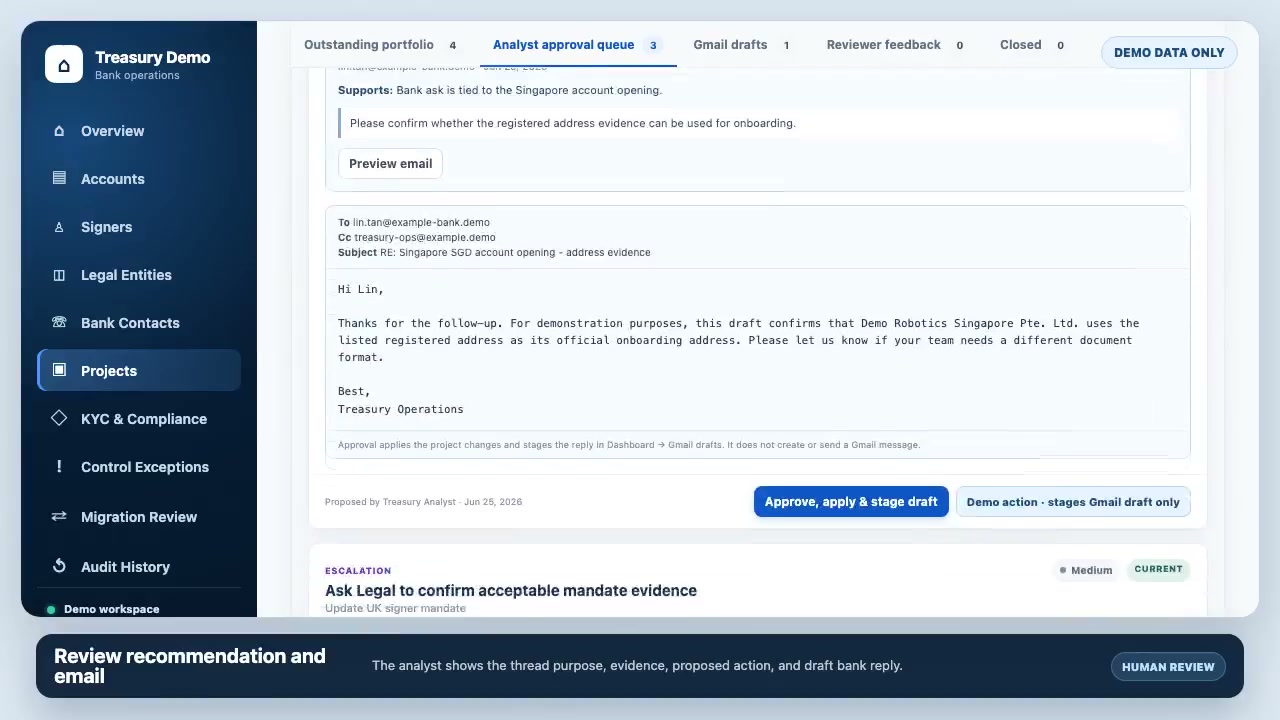
Caption: A specialist agent’s maturity is determined less by how many actions it automates than by how clearly it explains the source of evidence, the authority boundary, and where human approval stops.
Final Bonus Day | Finance Orchestrator: From Multiple Agents to a Cross-Organizational Operating Model
Business problem
A Strategic Finance partner may support more than ten teams, each with different priorities, datasets, metrics, vocabulary, and cadence. Budget refreshes, BvA commentary, forecasts, headcount reporting, ROI analysis, and executive materials arrive in parallel.
Creating one agent for each team can create a new form of fragmentation: inconsistent KPI definitions and snapshots, duplicated forecast logic, lost evidence during handoffs, cross-team context leakage, and partial failures treated as complete work. More agents do not automatically create an operating model.
Marco Kim presents a conceptual architecture of more than ten org-specific StratFin agents coordinated by a central Finance Orchestrator and sharing Headcount, Budget, Forecast, Variance, and Insights capabilities. The video names Government, Product Policy, Global Affairs, Legal, and Communications agents and shows illustrative Legal and Global Affairs outputs.
Inputs and context
The author’s description presents specialist agents, shared Skills/Plugins, and a central orchestrator. Turning that public architecture into a production design would require at least three clearly separated layers.
The shared capability layer includes budget and actual ingestion, forecast refreshes, BvA bridges, headcount reconciliation, narrative drafting, dashboard rendering, source citation, and control-total checks. Every capability needs an input contract, output schema, owner, version, tests, permitted tools, and an approval boundary.
The org-specific context layer contains authorized sources, local KPI mappings, cadence, materiality, strategic frameworks, business vocabulary, audience, and reviewer. Local context may extend shared capabilities but must not silently fork common metrics.
The orchestration and governance layer handles routing, permission checks, dependencies, handoff schemas, timeout, retry, cancellation, partial failures, output checks, exception queues, human review, and controlled publishing.
AI’s role
Specialist agents call shared capabilities within their authorized organizational scope. The orchestrator determines the authoritative organization and entity, checks source permissions and dependencies, dispatches work, maintains run state, collects specialist outputs, and triggers independent checks before final review.
The orchestrator should manage workflow state, not become another free-form analyst. It must not invent missing conclusions to complete a combined deliverable or mark a worker timeout as complete. Every handoff should retain a run ID, as-of date, agent/Skill/Plugin version, source references, and output schema.
The public video shows designed architecture animations and sanitized output forms, not an execution record. It does not show agent threads, route decisions, tool calls, handoff payloads, check results, approvals, failure recovery, or deployment logs. Claims about scheduling, parallel work, quality checks, and the orchestrator creating the video remain author statements.
Human role
Finance partners move from assembling every deliverable to framing questions, setting priorities, defining acceptance criteria, challenging assumptions, and approving outputs. Shared Finance/Data teams own common data contracts, metrics, Skills/Plugins, and tests. Org Finance owns local context, strategic judgment, exceptions, and audience decisions.
A shared Skill update can change multiple teams’ outputs. A routing error can expose cross-org data. A metric conflict can propagate across the portfolio. Finance therefore needs to launch, monitor, evaluate, version, degrade, and retire agents as a group of long-running services.
Reusable asset
The Final Bonus Day can become a Finance agent operating model:
- a shared capability registry with contracts and tests;
- an org-context registry with entitlements and local reviewers;
- deterministic routing, dependency graphs, and handoff schemas;
- common run IDs, snapshots, and metric versions;
- timeout, retry, cancellation, and partial-failure policies;
- independent checks, exception queues, and human approval;
- claim-level lineage and controlled publishing;
- usage, quality, cost, change, and retirement records for agents, Skills, and Plugins.
Agent count is not a success metric. A separate agent is justified only by a distinct context, access boundary, capability set, reviewer, or cadence. Otherwise it adds routing and maintenance cost without meaningful specialization.
Practical starting scope
Start with two organizational contexts and one orchestrator, not ten agents. Org A handles cost-center BvA and forecast refreshes. Org B handles headcount and program-ROI review. Both share source validation, a budget/actual bridge, a narrative schema, and output QA.
Add one conflicting metric definition, one restricted source, one stale snapshot, one worker timeout, and one unsupported claim. Pass only if routing is deterministic, no cross-org data leaks, the metric conflict escalates, all outputs use the same approved snapshot, partial failure blocks finalization, claim lineage survives handoffs, and reviewers can accept, modify, or reject each specialist output.
Public evidence boundary: The video directly shows a Finance Orchestrator, org-specific agent cards, a shared capability layer, and two masked or illustrative outputs. Actual agent definitions, prompts, Skills, Plugins, source permissions, routing, execution, evaluations, approval, and production status are not public.
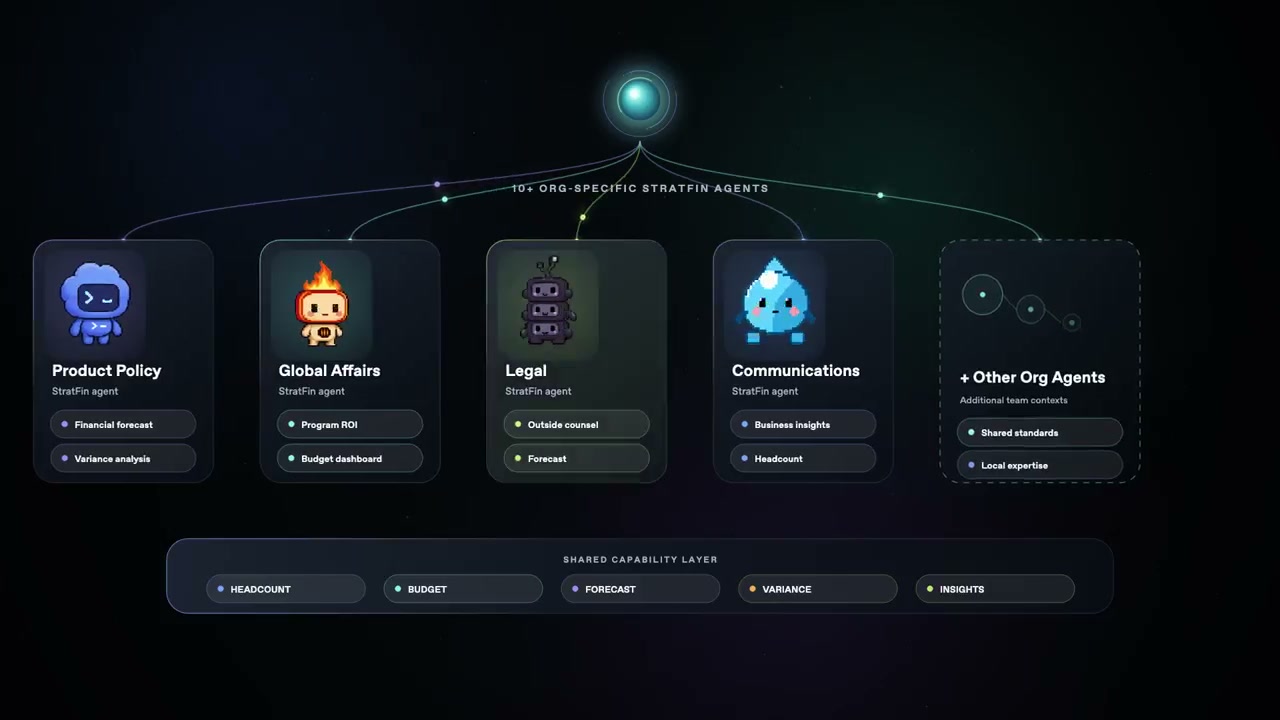
Caption: Central orchestration is not one agent deciding everything. Its job is to preserve shared standards and local boundaries, then stop, hand off, and remain accountable when failures or exceptions occur.
Final Synthesis: Finance Is Moving from Files to Managed Capability Portfolios
The four Bonus Days cover dashboard iteration, a business analytics engine, a Treasury workflow, and a multi-agent operating model. From AI4FIN’s analytical perspective, they are not four unrelated demos, but four levels of the same expansion path.
Interfaces become workspaces for expressing finance intent
Bonus Day 13 lets Finance annotate a live page rather than translate every visual change into a separate ticket. That shortens product iteration, but interface feedback does not replace metric definitions, query tests, or release control.
Finance will participate more directly in building analytical products. Data and Engineering will concentrate more of their value in trusted data, semantic layers, testing, platforms, and permissions.
The reusable asset is not a dashboard, but a governed ability to answer new questions
Bonus Day 14 matters because new questions can reuse common metrics, mappings, snapshots, and calculation components. A real analytics engine must distinguish between a new cut of an approved definition and a genuinely new definition requiring owner approval.
If a system always returns an answer but cannot identify its data and metric version, it only accelerates ad hoc analysis. Queries, calculations, lineage, and reviewer decisions make it an organizational asset.
Authority boundaries matter more than the number of automated actions
Bonus Day 15 places an agent in high-risk Treasury work without designing it as an autonomous executor. The most important visible states are approval queue, stage draft only, and No email was sent.
Production design should begin with permissions: what the agent may read, recommend, apply, stage, send, execute, and approve. The closer a workflow gets to banking, payments, KYC, signatory authority, and external communication, the less those boundaries can be hidden in a prompt.
Multi-agent finance is a governance problem, not a scale claim
The Final Bonus Day separates shared capabilities, local context, and orchestration. A universal Finance agent is not enough; copying one agent per team is not enough either.
Shared capabilities need common owners and regression tests. Local contexts need entitlements and reviewers. Orchestration needs state, failure handling, and lineage. Without all three, spreadsheet sprawl becomes agent sprawl.
From Day 1 to the Final Bonus Day
Across all sixteen cases, finance AI moves from point assistance toward an operating system through a clear expansion path:
Operating signals and finance inputs
→ Executable work units
→ Cross-tool and cross-time-grain consistency
→ Exception, review, and approval states
→ Reusable models, content, and knowledge
→ Analytical products that answer new questions
→ Specialist agents with authority boundaries
→ Cross-organizational shared capabilities and orchestration
The public materials do not prove that AI can run a finance function independently, or that every prototype is deployed in production. Many screens use synthetic, demo, sanitized, or illustrative data; full data, code, prompts, Skills, Plugins, permissions, tests, and operating logs are rarely public.
The public materials more strongly support a narrower conclusion: Finance can progressively encode its working methods into data contracts, calculation components, interfaces, workflows, specialist agents, and shared capability layers. Human work shifts away from repeated assembly and toward defining metrics, designing boundaries, handling exceptions, challenging conclusions, approving actions, and managing a portfolio of continuously operating digital capabilities.
The term Finance Operating System in this feature is AI4FIN’s synthesis of the common conditions across the case series. It is not an official OpenAI product name, nor does the public evidence prove that a complete internal system already exists. It is not a super-agent or a chat window connected to every dataset; it requires at least six common conditions:
- Controlled facts: source snapshots, as-of dates, metric registries, entity mappings, and semantic layers;
- Deterministic calculation: formulas, queries, reconciliation, control totals, and regression tests;
- Workflow state: exception, review, approval, staging, publication, supersession, and failure;
- Authority boundaries: separation of read, recommend, apply, stage, send, execute, and approve;
- Evidence and lineage: citations, versions, run IDs, decisions, and overrides;
- Capability governance: owners, evaluations, cost, reuse, change management, and retirement.
The destination of the final four Bonus Days is not “Finance has more agents.” It is a new management object: digital capabilities that can be composed, tested, handed off, constrained, and retired when they no longer fit.
For Finance leadership, the practical starting point is still not a global transformation. Select one frequent, reconcilable workflow with explicit boundaries. Establish a common source, exception queue, and human approval. Run it for several cycles and record reviewer edits, failures, and post-publication corrections. Then decide which capabilities merit reuse, which contexts justify specialist agents, and which actions should always remain with humans and controlled systems.
Primary sources
- Bonus Day 13 | Kevin Cong (activity-ID URL; public access may depend on LinkedIn login state): https://www.linkedin.com/feed/update/urn:li:activity:7476663687668228096/
- Bonus Day 14 | Jacob Blau: https://www.linkedin.com/posts/jacob-blau_12daysofchatcodexstratfin-activity-7477119200969269248-xajZ
- Bonus Day 15 | Jane Ro: https://www.linkedin.com/posts/janecro_12daysofchatcodexstratfin-activity-7477391114749005825-Ecg0
- Final Bonus Day | Marco Kim: https://www.linkedin.com/posts/marcodkim_12daysofchatcodexstratfin-activity-7477767727005454336-y-sC
- OpenAI Codex: https://openai.com/codex/
- OpenAI | Introducing the Codex app: https://openai.com/index/introducing-the-codex-app/
- OpenAI | Codex for (almost) everything: https://openai.com/index/codex-for-almost-everything/
- OpenAI | Inside OpenAI’s in-house data agent: https://openai.com/index/inside-our-in-house-data-agent/
- OpenAI Agents SDK | Orchestrating multiple agents: https://openai.github.io/openai-agents-python/multi_agent/